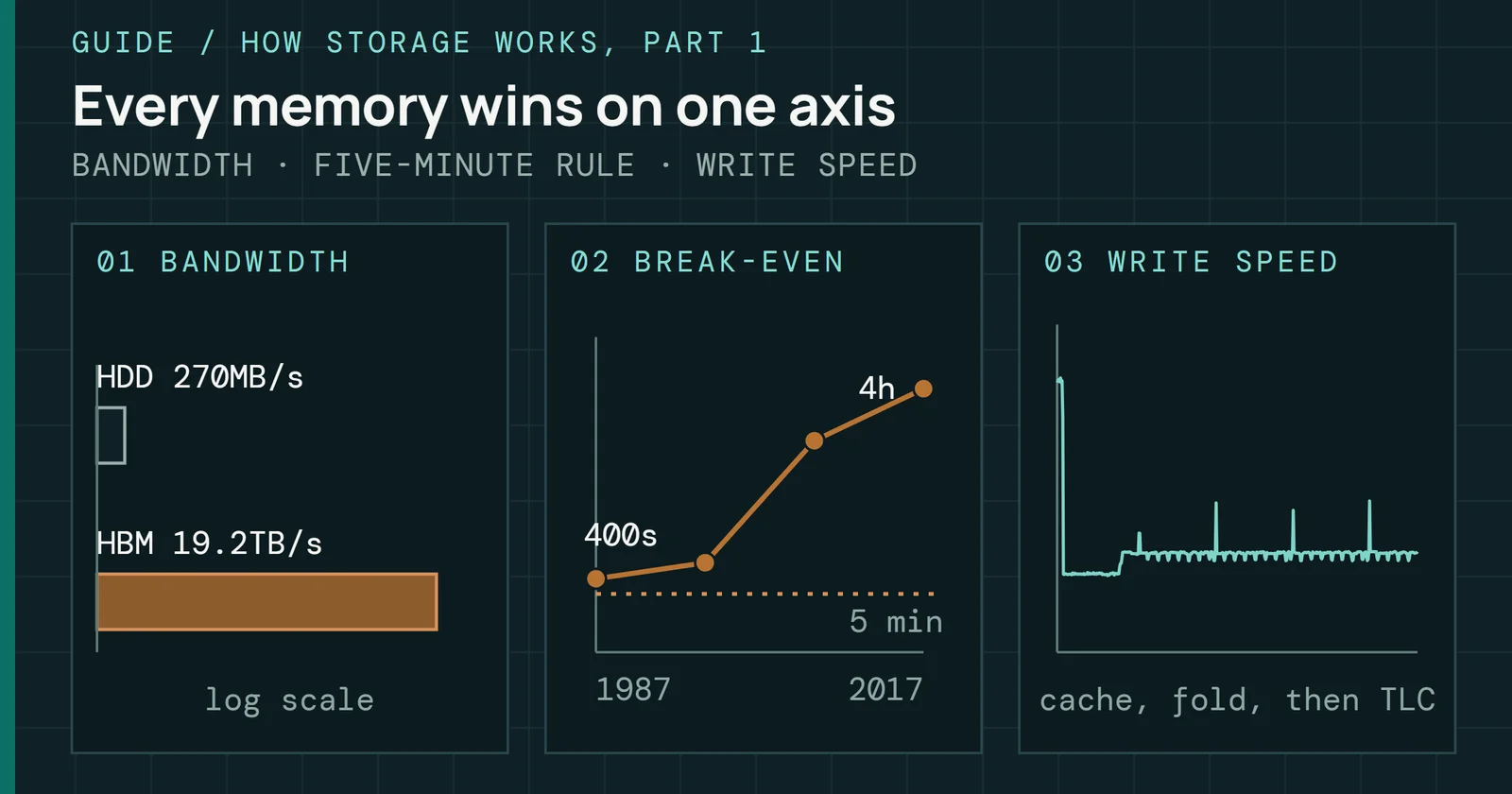
Part 1 left tape at the bottom of the memory and storage hierarchy, in Linear Tape-Open (LTO) cartridges of 30TB or 40TB native. This part asks what can sit beneath it today and what is still research.
How Storage Works
How Storage Works, Part 3: Tape and Cold Archive
How LTO tape stores data and why it still wins on cost and power at rest, then what optical archive, glass and DNA storage are today and what is still research.
On this page 7 sections
IEEE’s 2026 roadmap reports optical disc cartridges as a product line, and glass and DNA as laboratory results. The gaps show in the write rates. A laboratory glass writer reaches 3.2MB/s where an LTO-10 drive streams up to 400MB/s, and the DNA Data Storage Alliance puts typical DNA write throughput at about 0.001MB/s.
How tape writes and reads
A tape drive is a magnetic recorder like a hard drive, but with many write channels at once. Where a disk drive has one active recording channel, state-of-the-art tape drives record and read-verify 32 tracks in parallel, according to IEEE’s roadmap. A three-module head does the work. The center module holds 32 data readers and two servo readers that track the head’s position. A writer module on each side holds 32 data writers. One writer records while the tape runs forward and the other while it runs in reverse, and the center readers check the data as it is written. With error correction on top of that verification, tape reaches bit error rates four orders of magnitude better than disk products.
How tape writes and reads
A tape head writes 32 tracks at once, then runs back for more
LTO-10 head modules and the serpentine path of the tape
The lower panel of Figure 3.1 draws the path of those passes. Thirty-two tracks is one pass. IBM’s documentation says LTO-10 drives read and write 15,104 tracks across the tape in groups of 32, so 472 passes fill a cartridge. Four data bands split the tape, and each band takes many passes. A pass runs the length of the tape, the head steps over, and the next pass runs back the other way. IBM’s tape library guide calls this linear serpentine recording, and it fills the innermost bands first so the earliest data sits where the tape is most stable.
Tape starts slowly because the drive must first reach the right spot. A robot loads the cartridge and the drive winds to the right pass, so IEEE’s roadmap puts access latencies in the range of tens of seconds, and Appuswamy and colleagues list 65s for a small 2017 library. Once the head is in place, an LTO-10 drive streams at up to 400MB/s native. LTO-5 introduced the Linear Tape File System (LTFS), and LTO-10 supports it. With LTFS a single cartridge behaves like network-attached storage, so the host sees files rather than positions.
What an LTO cartridge holds
LTO is an open format that Hewlett Packard Enterprise, IBM, and Quantum develop and the LTO Program promotes. Each cartridge carries its native capacity on the label. It is the amount a drive writes with no help from compression. IBM’s documentation lists 2.5TB for LTO-6 and 6TB for LTO-7. On the Program’s pages LTO-8 holds 12TB native and LTO-9 holds 18TB. LTO-10 comes in 30TB and 40TB cartridges. Per the LTO Program a thinner aramid base film gives the 40TB cartridge its extra 10TB by fitting more tape in the same shell. IEEE’s roadmap reports IBM’s TS1170 enterprise format as announced in 2023 at 50TB native.
What an LTO cartridge holds
LTO-10 holds 40TB native, 122% more than LTO-9
Native capacity per cartridge; the dimmer number above a bar is the compressed label at 2.5:1
Compressed capacity is the other label the LTO Program quotes, 75TB and 100TB for LTO-10 in Figure 3.2, and it assumes 2.5:1 compression, a ratio it ties to the larger compression buffer in generation 6 drives and later. Drives compress in hardware, on by default, and data that cannot be compressed goes through unchanged. A cartridge therefore holds its native capacity for incompressible data, and 2.5 times that only when the data shrinks by that ratio.
Capacity grew faster than speed. Both LTO-9 and LTO-10 can stream up to 400MB/s native. Filling a 40TB LTO-10 cartridge therefore takes at least about 28 hours, against at least about 12.5 hours for an 18TB LTO-9 cartridge. For compressed speed the LTO Program quotes up to 1,200MB/s for LTO-10 on a 32Gb Fibre Channel interface, while IEEE’s roadmap gives up to 1,000MB/s at 2.5:1. Since 400 times 2.5 is 1,000 the sources disagree. This page uses the native 400MB/s rate.
LTO-10 drives do not support LTO-9 cartridges. Backward compatibility was given up to fit a redesigned tilted head and the higher capacity. That head also removes the need to initialize cartridges. Whether LTO-11 reads LTO-10 will be decided when that generation is specified. The LTO roadmap lists four planned future generations without dates, and IEEE’s roadmap notes that recent generations have arrived every three to four years.
Why tape wins on cost and power, and what it gives up
The cost case starts with media. Tape media runs under 5 USD per terabyte, against over 10 USD for a 22TB hard drive, and a library spreads each drive over 50 to 100 cartridges. A small library does not show that price. Part 1 works through a 2017 library with four drives and 10 cartridges, which cost more per gigabyte than a hard drive because the drives and robot were spread over so few cartridges.
Why tape wins on cost and power, and what it gives up
Studies find tape saves 82% or more on cost, carbon and power
Reductions for tape against the alternative, as relayed by IEEE’s 2026 roadmap
Two studies relayed by the roadmap put numbers on running costs, drawn in Figure 3.3. A 10-year study by Solutions North Consulting found an 82% lower cost for an LTO-9 tape solution than for an HDD-based one, and 95% lower than a managed storage provider. An IBM study of a 27PB archive found 96% lower carbon dioxide equivalent emissions and more than 90% less power than a hard drive system built to the Open Compute Project’s Bryce Canyon design. As the roadmap notes, removable cartridges give tape a very low power draw per petabyte and a physical air gap against accidental deletion and cyber-crime.
Tape trades away time and flexibility. Its first byte takes tens of seconds, and LTO-10 gave up reading the previous generation’s cartridges. Part 1’s break-even sums, which use 2017 prices, put data kept for years and read in bulk on tape, and data read more often than that on a hard drive or flash. This guide reads the roadmap numbers as a cost lead for that bulk, cold case. Those studies come from a consulting firm and from IBM, so they are third-party and maker figures, not measurements of ours. Hard drives for archive data are in the high-capacity archive tier of Best HDDs.
Optical archive: discs in a cartridge
Sony and Panasonic developed the Archival Disc, which IEEE’s roadmap reports as the size of a Blu-ray disc with three layers per side, an initial 300GB for 2016 and designed to be readable for at least 50 years. A second generation in 2020 reached 500GB by shortening the data bit length. Sony’s third-generation Optical Disc Archive (ODA) cartridge holds 5.5TB on double-sided discs with three layers per side, and the roadmap counts 11 of those 500GB discs in it, against 3.3TB for the generation before.
Optical archive: discs in a cartridge
A third-generation cartridge holds 11 discs and 5.5TB
Sony Optical Disc Archive, as the IEEE 2026 roadmap reports it
Its drive, in the right panel of Figure 3.4, has eight lasers and reads and writes both sides of a disc at once, reaching 375MB/s read and 187.5MB/s write, which Sony states as 3Gbps and 1.5Gbps. Read speed is close to tape’s 400MB/s streaming rate, on a cartridge that holds 5.5TB against LTO-10’s 40TB. On price, IEEE’s roadmap says LTO-10 tapes at around 5 USD per terabyte are about an order of magnitude cheaper than the optical competitors, which include BDXL and the Sony and Panasonic discs.
IEEE’s roadmap notes that as of December 2023 some of the Sony library products it describes were discontinued, and it lists no Sony generation after the third. This page found no sourced successor, so the record of optical archive here ends with the 2020 generation. Start-ups are working on other optical media, and the roadmap reports that Cerabyte ablates a dark ceramic layer on glass to write a pattern like a QR code.
Glass: dense, slow to write and unproven for decades
Microsoft Research’s Project Silica stores data inside glass using femtosecond laser pulses, each one making a tiny three-dimensional pixel called a voxel. Its Nature paper, published February 18, 2026, reports two ways to do it. One method writes birefringent voxels into pure quartz glass (fused silica). On a platter 120mm square and 2mm thick it reaches 1.59Gbit/mm³ and a usable 4.84TB, in 301 layers 6µm apart. The other writes phase voxels into borosilicate glass, which Microsoft calls readily available and lower in cost, and reaches 0.678Gbit/mm³ and 2.02TB across 258 layers. Both capacities are usable bytes, after a factor of 0.747 for engineering overheads. Figure 3.5 sets the two methods side by side.
Glass: dense, slow to write and unproven for decades
Silica stacks 301 layers in fused silica, 258 in borosilicate
Two writing methods from the Project Silica Nature paper, February 18, 2026
Writing is the weak side. Writing runs at 25.6Mbit/s for the fused silica method and 18.4Mbit/s for the borosilicate one in the paper, which is 3.2MB/s and 2.3MB/s, and four beams written in parallel reached 65.9Mbit/s. An LTO-10 drive at 400MB/s native writes 125 times as fast as the 3.2MB/s glass figure.
On durability, accelerated-aging tests extrapolate to a lifetime above 10,000 years at 290°C for phase voxels in isolated glass, a figure the authors say leaves out mechanical stress and chemical corrosion. Microsoft’s blog said in February 2026 that the research phase of Project Silica was complete, and the sources hold no product or price. IEEE’s roadmap reports a company, SPhotonix, single-beam systems writing at around 4MB/s and an aim of 500MB/s from one 20W laser. Those are company figures relayed by the roadmap. This guide reads Silica as a medium for data written once and left alone, because the sourced write rates sit two orders of magnitude below tape’s.
DNA storage is a write-speed and cost problem
DNA stores data as the order of bases in synthetic strands. The DNA Data Storage Alliance publishes through SNIA, and its technology review credits DNA with information density orders of magnitude above traditional media. Kept away from oxygen, water, and ultraviolet light, it is stable for several decades to centuries at ambient conditions. The Alliance’s first specification measures stability as a half-life, the time for half the molecules in a pool to remain intact at 25°C.
Writing is the gap. Table 3 of the June 30, 2025 review puts DNA at about 100MB/day, which is 0.001MB/s, against about 400MB/s uncompressed for tape, 300MB/s for a hard drive, and 1,000MB/s for an NVMe SSD. Dividing tape’s 400MB/s by the rounded 0.001MB/s gives a gap of about 400,000-fold, as Figure 3.6 shows on one log scale. Write latency is seconds to minutes to the first byte, which compares well. Each strand holds only tens of bytes, and base-by-base synthesis tops out at 300 to 500 bases per strand, so a file is split across a great many strands.
DNA storage is a write-speed and cost problem
DNA writes about 400,000 times slower than tape
Write throughput, MB/s, on one log scale
Reading is a sequencing job. The Alliance puts Illumina’s NovaSeq X at about 12MB/s and Oxford Nanopore’s PromethION at about 1MB/s. Cost has no commercial price yet. IEEE’s roadmap estimates synthesis at several hundred to several thousand dollars per megabyte for the newest laboratory techniques and says cost estimates for commercial solutions are unavailable. LTO-10 media at around 5 USD per terabyte is 0.000005 USD per megabyte, so the laboratory figure is more than 20 million times as much, comparing a writing cost with a media price.
Five challenges stand between DNA and commercial use in the Alliance’s assessment. They are data throughput, total cost of ownership, media endurance and data retention metrics, biosecurity and data security, and standardization. As of November 2026, DNA is a research result with a standards effort behind it.
Where cold storage goes from here
IEEE’s roadmap gives dated projections for tape and none for optical, glass, or DNA. Its table puts native cartridge capacity at 70TB in 2028 and 640TB in 2040, with native drive rates from 600MB/s to 3,000MB/s. Those are the roadmap’s projections for the tape industry, not LTO Program commitments, and the roadmap points to room to scale in tape’s areal density, about 42 times lower than a hard drive’s. Figure 3.7 draws them beside today’s cartridge.
Where cold storage goes from here
IEEE projects 640TB native tape cartridges by 2040
Native capacity per cartridge, today’s LTO-10 and the roadmap’s projections
Write rates and prices are the numbers to watch. SPhotonix aims for 500MB/s from one laser. That company target sits against the 600MB/s the roadmap projects for tape in 2028. The next datapoints would be that 2028 tape step, a glass writer reporting rates well above the paper’s 3.2MB/s, and a priced DNA service. The roadmap says cost estimates for commercial DNA solutions are unavailable today. Part 4 takes up the link that carries data to and from a drive.
Sources
Primary is the original paper, standard or datasheet. Secondary is a review, a vendor summary or a news report. Measured is my own test data.
Show all 12 sources, 12 primary
- PrimaryIBM Tape Library Guide for Open Systems (SG24-5946-18, August 2024)redbooks.ibm.com, 2024
- PrimaryDNA Data Storage Technology Review, Version 1.0snia.org, 2025
- PrimaryInternational Roadmap for Devices and Systems 2026: Mass Data StorageIEEE IRDS, 2026
- PrimaryLaser writing in glass for dense, fast and efficient archival data storageNature, 2026
- PrimaryProject Silica’s advances in glass storage technology featured in NatureMicrosoft Research, 2026
- PrimaryLTO data cartridge, IBM TS4500 1.12.0 documentation (publisher page printed to PDF)IBM
- PrimaryLTO-10: LTO Generation 10 TechnologyUltrium LTO
- PrimaryLTO-8 Technology: LTO Generation 8Ultrium LTO
- PrimaryLTO-9: LTO Generation 9 TechnologyUltrium LTO
- PrimaryOptical Disc Archive Cartridge Generation 3, ODC5500R (Sony Pro product page printed to PDF)Sony
- PrimaryRoadmapUltrium LTO
- PrimaryThe Five-minute Rule Thirty Years Later and its Impact on the Storage HierarchyAppuswamy, Borovica-Gajic, Graefe, Ailamaki (EPFL Infoscience, ADMS 2017)