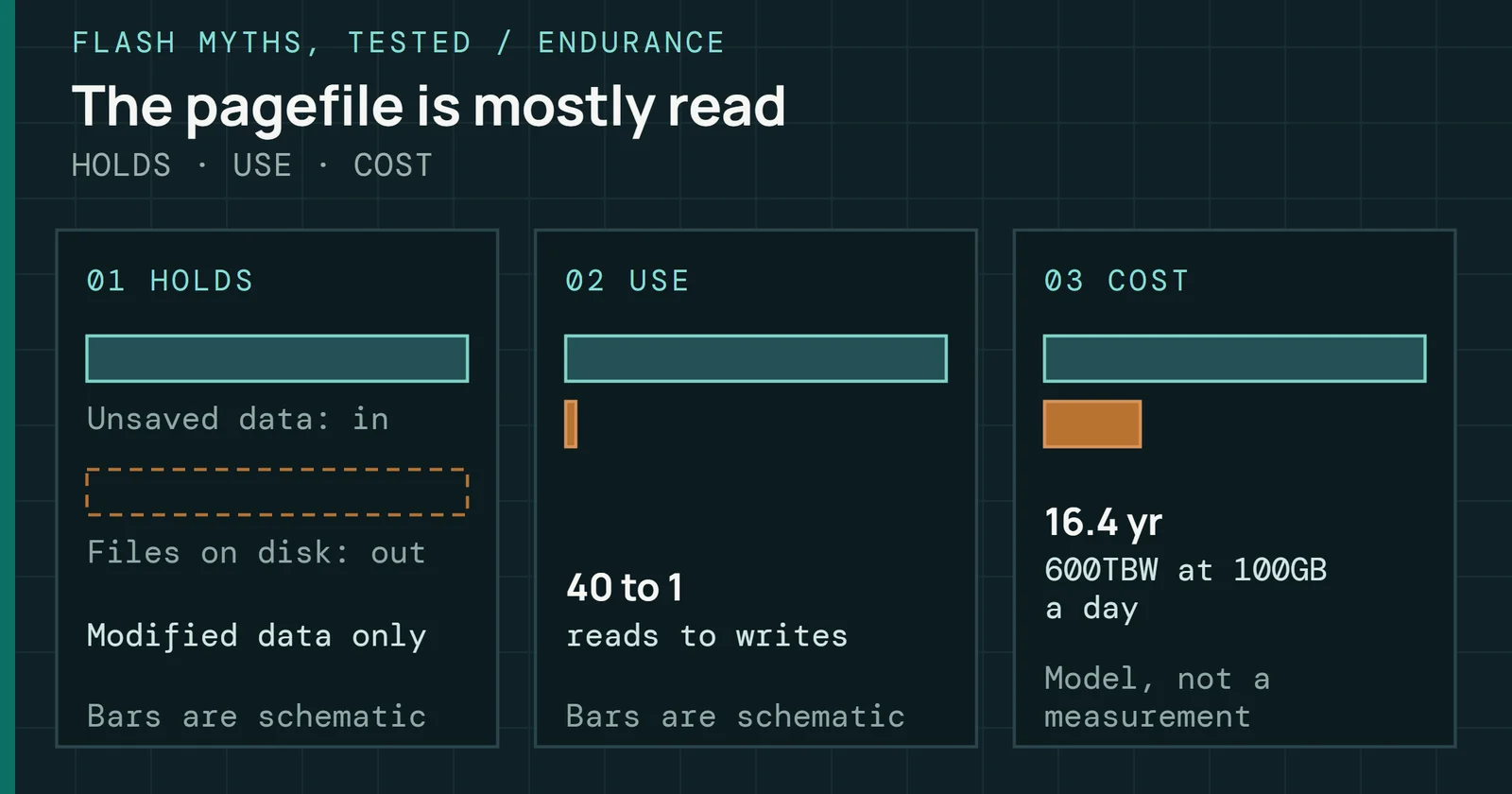
In January 2021, Tesla began a voluntary recall of 134,951 Model S and Model X vehicles whose 8GB Hynix eMMC could reach the end of its rated life through regularly accumulated wear. Tesla’s report to the U.S. National Highway Traffic Safety Administration (NHTSA) calls the part’s rating of 3,000 program/erase (P/E) cycles industry standard. Public documents show automotive flash wearing out here, and that is why this part treats endurance as seriously as temperature.
Flash in Devices
Automotive and Industrial Flash: Built for Heat and Wear
Why cars and factories need different flash: AEC-Q100 and AEC-Q104 grades, retention, endurance under logging, power-loss protection and the Tesla eMMC recall.
On this page 11 sections
Part 1, UFS Explained, and Part 2, eMMC Explained, cover two interfaces that automotive parts use. Cars and factories do not change how those parts work. They change the questions a buyer asks: whether a temperature range is measured in the air or at the package, how long data lasts at the end of a part’s life, and what happens when power drops in the middle of a write.
ISO 26262 is a paid standard, so each functional-safety claim here is quoted as its maker states it. The Micron 4150AT figures come from EE Times and Micron’s blog and are attributed that way, since no datasheet was available.
Cars and factories ask more of flash than phones do
Four demands set this flash apart. Temperature comes first, and the others arrive with the qualification that tests it. SK hynix describes AEC-Q100 as a battery of stress tests involving temperature, vibration, dust and condensation, passed before a component is certified auto-grade. Swissbit is a Swiss maker of industrial storage, and its N3602 industrial SSD is rated for 1,500g shock and 50g vibration. Its industrial line is built for -40°C to +85°C operation and equipment lifecycles of 10 years or more.
Constant logging is the fourth demand. SanDisk positions its High Endurance microSD for dash cams and home monitoring systems, where a card records and re-records continuously, and rates it in hours of Full HD video from 2,500 hours at 32GB to 40,000 hours at 512GB. Western Digital’s automotive UFS drive lists digital cluster, infotainment, 3D map and navigation, telematics and ADAS as its workloads, with data flowing in and out of vehicles for real-time and offline analytics.
Cars and factories ask more of flash than phones do
Four demands on car and factory flash, with one rated value each
Cells are the ones consumer flash uses (Flash Foundations covers how they store a bit), and the controller does the same jobs. Differences are in what a maker tests, what it rates and how its firmware behaves when something goes wrong.
Temperature grades and module qualification
Reading a temperature range
AEC-Q100 is the Automotive Electronics Council’s stress-test standard for chips, and it sorts parts into grades by ambient operating range. Grade 3 tops out at 85°C and Grade 2 at 105°C, with Grades 1 and 0 above them. Beyond NAND Part 1 has the full grade table and the high-temperature life test, so this page only uses the grades.
Ambient is the air around a part, and case is the package surface. JEDEC’s JESD402-1 measures UFS temperature at the case, at the center of the top of the package, as Part 1 covers in UFS cards and cars. A datasheet’s 105°C can mean either, and the two differ. In Micron’s automotive eMMC 5.1 datasheet, AAT parts reach 105°C ambient or 115°C at the hottest point of the case, and AIT parts reach 85°C ambient or 95°C at the case. Micron’s part-number suffixes mark the class: IT industrial, AT automotive, and four more for wireless, wide, ultra and extreme temperature. Only the datasheet gives the real range, and the AAT and AIT figures above show why it matters.
Temperature grades and module qualification
Top of the operating temperature range, ambient and at the case
The embedded-storage supplier AMP sells one BGA SSD platform in three grades. Commercial runs 0°C to 70°C, industrial to 85°C and automotive to 105°C, all at the case, and the automotive grade lists AEC-Q100 Grade 2. At the top of Figure 2, the UFS 4.1 parts from Micron and Kioxia reach 115°C at the case, 10°C beyond JEDEC’s standard 105°C, as Micron’s own release frames it.
AEC-Q104 for multi-chip modules
AEC-Q100 was written for chips, and a module of several chips adds connections that can fail. AEC-Q104 is the council’s stress-test qualification for multichip modules (MCMs) for that reason. It defines an MCM as multiple active or passive subcomponents interconnected into one complex circuit in a single package intended for reflow solder attachment to a board. An eMMC or UFS device puts a controller and NAND dies in one package, which fits that description.
It covers the completed module only. It does not qualify each subcomponent, though it encourages module makers to use AEC-qualified ones when available, and it sets no temperature grades of its own. Typical ambient ranges come from AEC-Q100 and the other AEC documents, and the supplier documents the module’s range in its datasheet and qualification report. For a module with nonvolatile memory, AEC-Q104 points to AEC-Q100-005 for preconditioning. Rev A is dated November 28, 2025, and the first release was September 14, 2017.
Makers use the labels differently. Kioxia’s automotive UFS 4.1 meets AEC-Q100/104 Grade 2 on the maker’s own account. Samsung’s AM9C1 SSD satisfies Grade 2 through intensified board-level tests, with stable performance up to 105°C.
Retention shortens with heat and wear
A flash cell holds data as stored charge, and retention is how long that charge stays readable with the power off. Heat speeds the leak. Luo and colleagues’ HeatWatch builds a model of self-recovery, temperature, retention loss and wearout for 3D NAND from an Arrhenius acceleration factor between retention times at two temperatures. Luo’s thesis gives an activation energy of 1.1eV for planar NAND. Put into the Arrhenius relation, that value gives our estimate of about 4x less retention time for every 10°C near room temperature. It is an estimate from a planar-NAND value, so it shows the shape of the effect and is not a figure to apply to a 3D part.
Makers rate retention at a stated temperature and a stated wear state. Swissbit’s N3602 data sheet rates 10 years at life begin and 1 year at life end, both at 40°C. Its storage technology page states the general rule as 10-year retention in early life, degrading to one year near the specified write limits. A drive at the end of its write budget keeps data a tenth as long as a new one. That data sheet also points out that NAND suppliers refer to JEDEC’s JESD47 and its related test-method standards for retention testing.
Retention shortens with heat and wear
Swissbit N3602 rated data retention at 40°C
Qualification covers the same ground from the other side. AEC-Q100-005 is the method for nonvolatile memory endurance, data retention and operational life, and Micron’s automotive eMMC datasheet lists retention as compliant with it. How that qualification runs is in Beyond NAND Part 1. Swissbit’s pair of numbers is the only maker retention rating in this page’s sources, so retention figures from two makers compare only when each names a temperature and a wear state.
Constant logging wears flash out
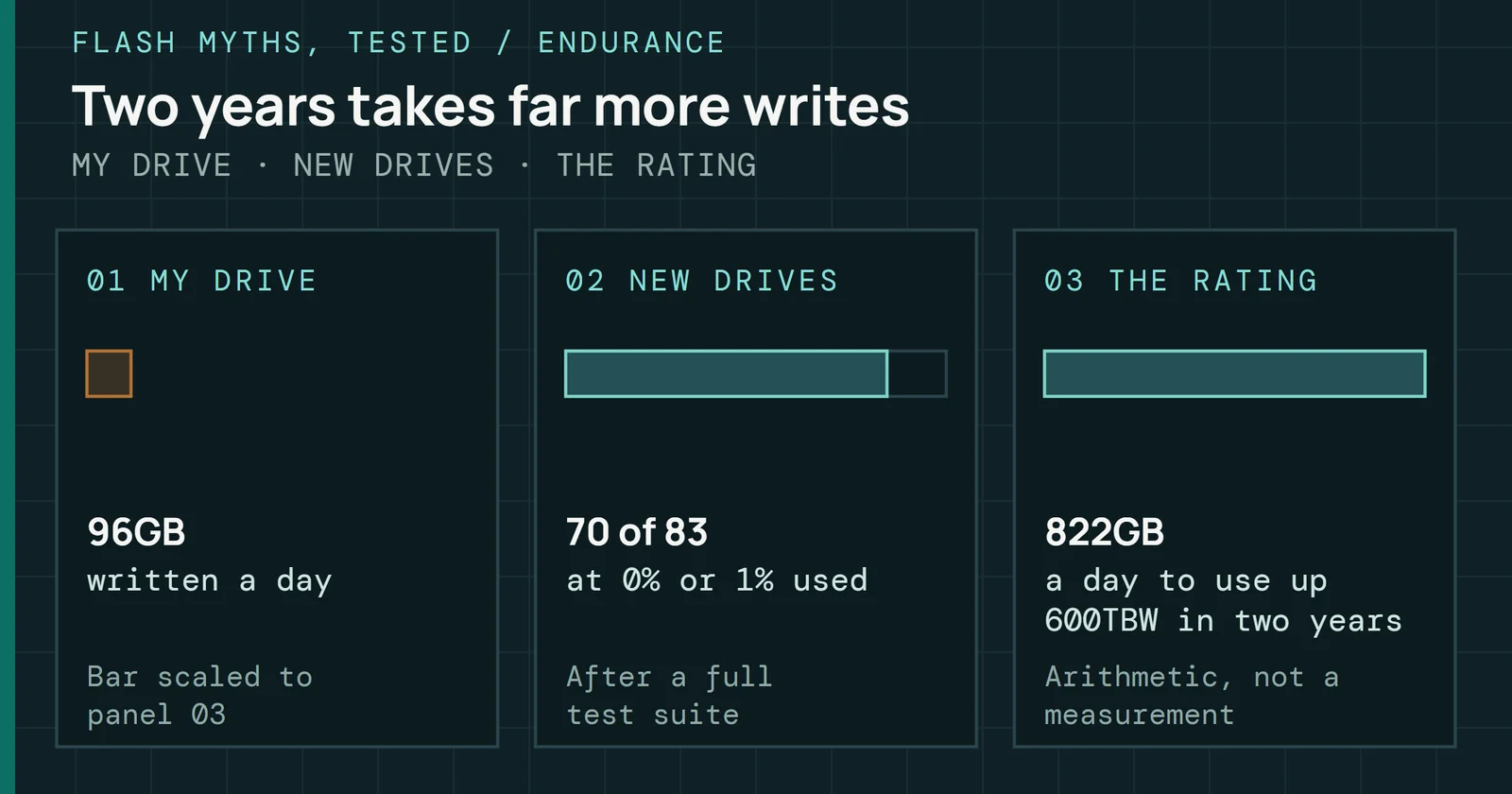
A logger writes all day, so the number that matters is how much it can write before the flash wears out. Kioxia’s technical brief defines the endurance of a managed device as terabytes written (TBW) = flash P/E cycles × flash density / write amplification factor (WAF), where WAF is the ratio of physical writes to logical host writes. A small write to a random address has a higher WAF than a larger sequential one, so the same flash lasts fewer terabytes. In Kioxia’s example a 128GB UFS device rated 192TB for 16KB sequential chunks falls to 96TB when the vendor measures 4KB chunks, so a 150TB load from an enterprise network security system writing random 4KB chunks would not fit. Kioxia works a camera case the same way.
Kioxia adds that eMMC and UFS parts specify endurance in P/E cycles, not the TBW and drive writes per day used for SSDs, and that the customer’s actual workload is the recommended basis for sizing. Micron’s automotive eMMC datasheet follows that pattern. NAND endurance is limited as specified in the device qualification document, which Micron provides on request, and no single TBW figure appears.
Constant logging wears flash out
Rated P/E cycles by cell mode
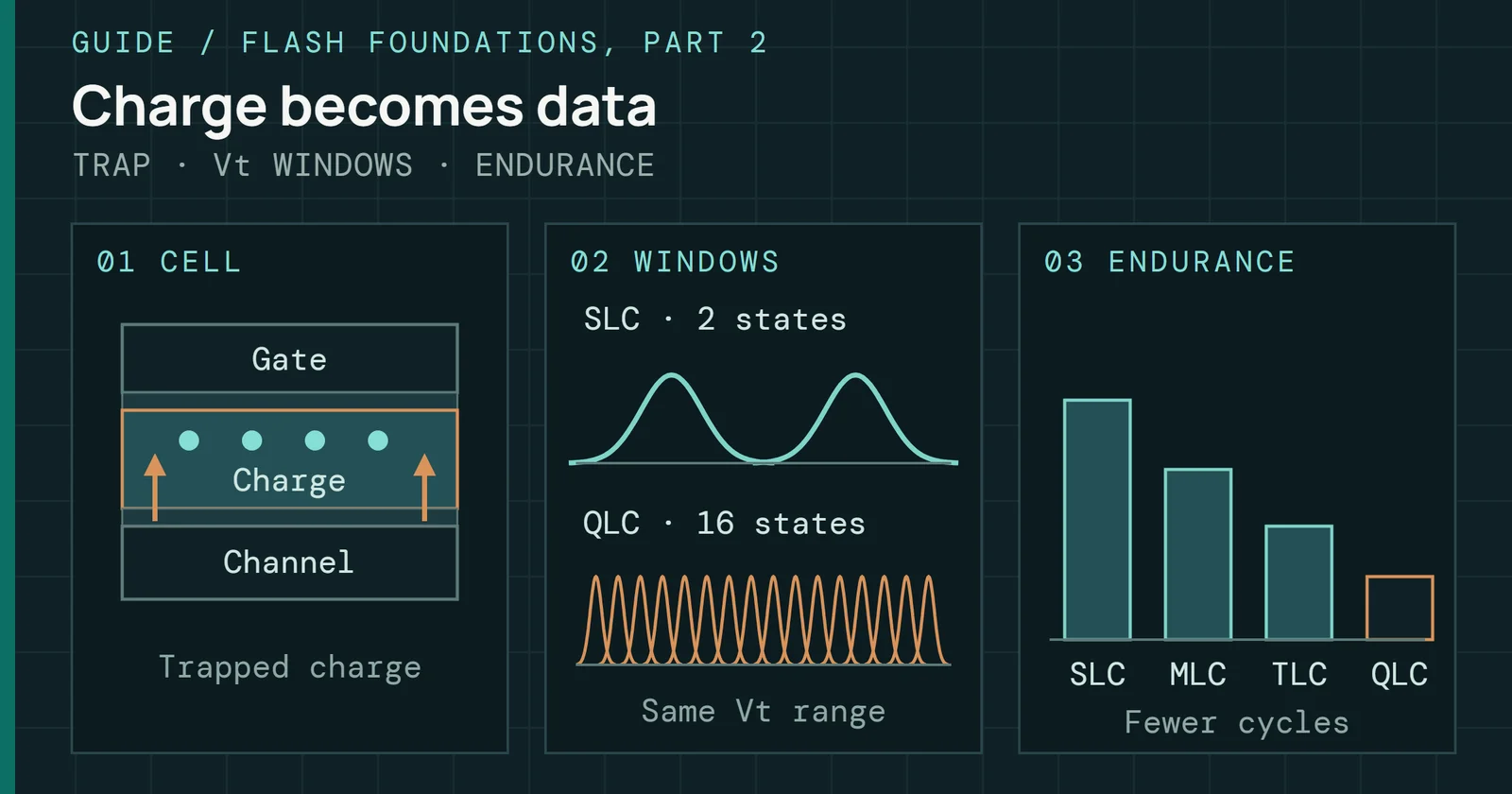
Swissbit rates endurance from NAND cycles of 100,000 for SLC, 3,000 for MLC and 3D TLC, and 1,000 for 3D QLC, then adjusts for FTL efficiency, overprovisioning and pSLC mode. The 3,000 cycles in Tesla’s recall report match the MLC and 3D TLC level. Pseudo-SLC (pSLC) mode stores one bit in a cell that could hold more, and Swissbit implements it to get SLC-like endurance out of MLC and TLC NAND. Micron’s eMMC FAQ treats the same trade as an enhanced attribute. A customer can split user data into up to four partitions, each MLC by default or enhanced (pSLC), and enhanced mode gives better reliability for twice the space. eMMC Explained covers how the enhanced area is set.
Kingston’s industrial microSD runs TLC NAND in pSLC mode at 30K P/E cycles and up to 3,840TBW, and Part 3 of Flash in Devices covers the card format. Our arithmetic is 128GB × 30,000 / 1 = 3,840TB, so the rating assumes a WAF of about 1. By Kingston’s account the figure is derived from the highest-capacity card and internal metrics rather than a standard test. Micron’s automotive UFS 4.1 rates up to 100,000 P/E cycles in SLC mode and 3,000 in TLC mode. EE Times reported that the 4150AT can be set up in endurance groups, with SLC rated 20 times as durable as TLC and high-endurance SLC 50 times, aimed at uses like black-box recording. Samsung adds a speed gain. Its AM9C1 reaches up to 4,700MB/s read and 1,400MB/s write in SLC mode, a figure given for no particular capacity, and SLC mode cuts capacity to one third of TLC. In TLC the 256GB model is rated up to 4,400MB/s read and 400MB/s write.
Health reports and power-loss protection
Industrial parts expose their wear so a host can act before the part fails. Micron’s automotive eMMC lists a device health report, auto-initiated and host-initiated refresh and production state awareness. The standard’s own health registers are in eMMC Explained. Production state awareness is mandatory when content is loaded before the part is soldered, and programming operations are supported only between 20°C and 55°C.
Swissbit’s N3602 goes further, with a life-end read-only mode, a drive self-test, and Data Care Management with adaptive read refresh and background media scan. It corrects errors with 240-bit LDPC per 2KB and lists an MTBF above 3 million hours. Kingston’s industrial microSD lists power failure protection, health monitoring, bad block management, wear leveling, garbage collection and dynamic data refresh.
Health reports and power-loss protection
What industrial parts watch, repair and protect
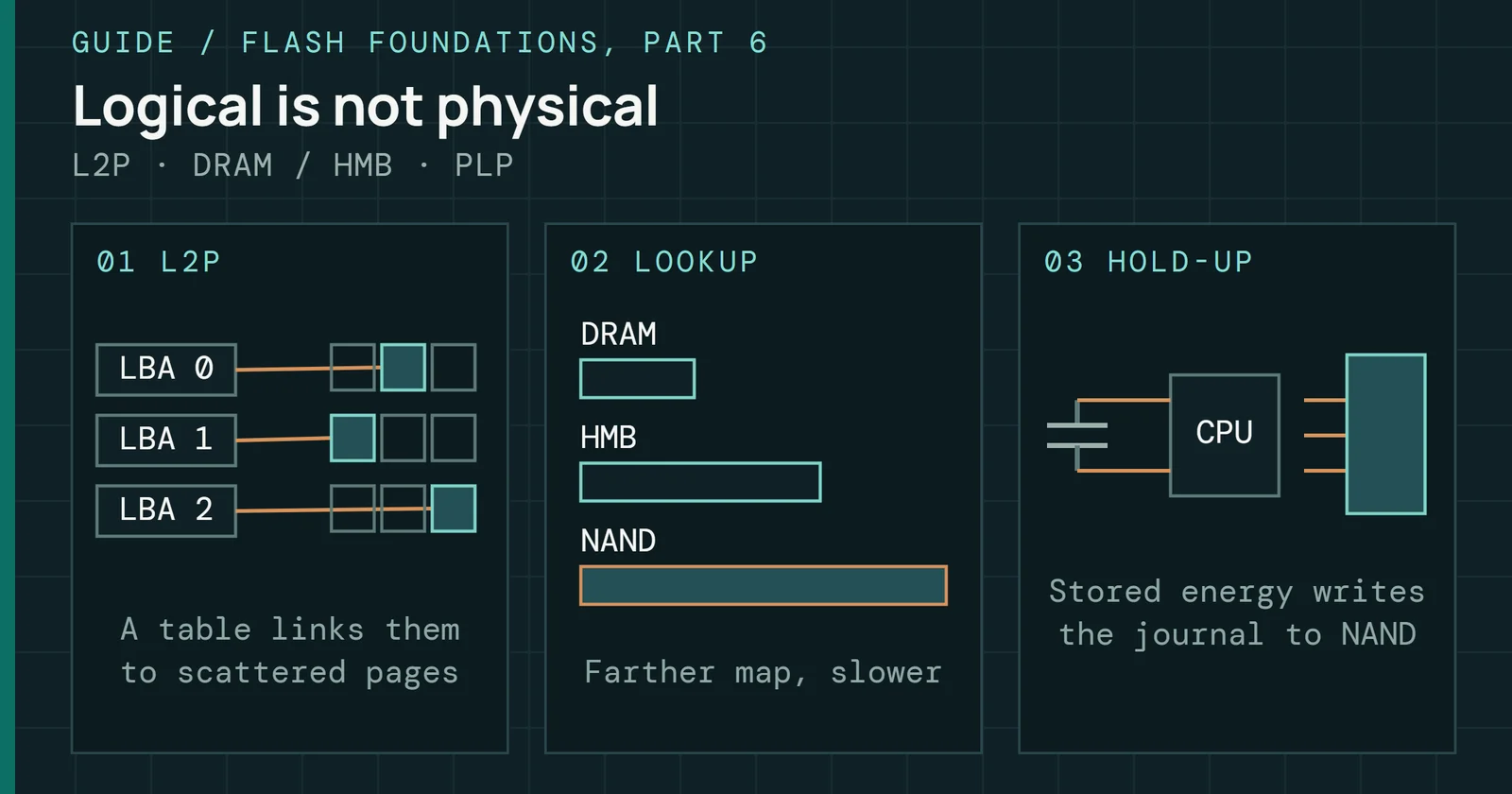
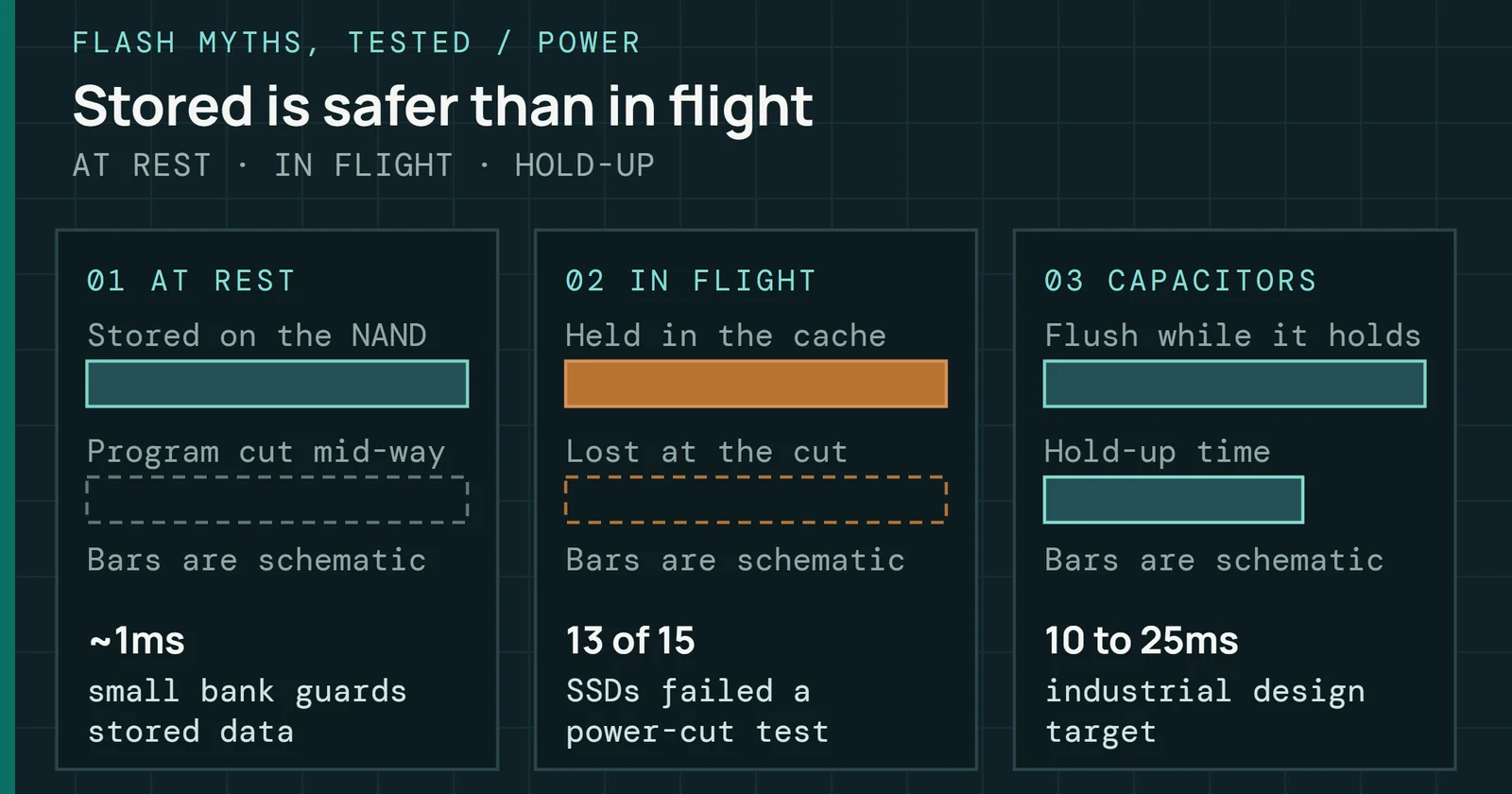
Sudden power loss is the other threat to logged data. Swissbit calls power loss protection (PLP) an essential, established safety feature of industrial SSDs against data loss in sudden outages. Its powersafe feature uses tantalum capacitors that store energy during operation, and on an outage the stored charge writes both in-flight host data and the DRAM cache to the NAND array. Swissbit validated it with 10,000 test cycles in which only write operations run during the outage.
AMP’s DRAM-less BGA SSD lists firmware power-loss protection at every temperature grade, on the product page as read in October 2026.
What the Tesla eMMC recall states
NHTSA opened Preliminary Evaluation PE20-010 on June 22, 2020, and upgraded it to Engineering Analysis EA20-003 in November 2020. Tesla began a voluntary recall, 21V-035, on January 27, 2021. NHTSA’s acknowledgment letter lists 134,951 potentially affected 2012–2018 Model S and 2016–2018 Model X vehicles with a center display on the Tegra 3 processor, and Tesla’s Part 573 report counts the same 134,951.
What the Tesla eMMC recall states
Recall 21V-035 from NHTSA’s evaluation to the recall letter
Those vehicles carry an NVIDIA Tegra 3 processor with an integrated Hynix (now SK hynix) 8GB eMMC NAND flash device. According to the report, the eMMC is rated for an industry-standard 3,000 P/E cycles, and the condition may occur when it reaches the end of its rated life through regularly accumulated wear. Once the NAND cells reach lifetime wear, measured by P/E cycles and remaining storage capacity, the eMMC controller can no longer maintain the integrity of the filesystem. The visible result is a blank center display. Wear-out can break the center display software and indirectly cause loss of the rearview camera display, defrost and defog settings and exterior turn signal lighting.
Tesla deployed over-the-air firmware updates in 2020 so that those functions keep working after the eMMC wears out. The remedy replaces the daughterboard carrying the Hynix 8GB eMMC with one carrying an enhanced 64GB Micron eMMC, free of charge, which in Tesla’s account gives improved lifetime wear and more capacity. Tesla’s service bulletin describes the recall as proactively upgrading storage from 8GB to 64GB.
This is our arithmetic and the recall does not state it: 8GB × 3,000 cycles = 24TB is an upper bound on what an 8GB part can absorb, reached only if write amplification is 1. Real write amplification lowers it. The recall gives no rating for the 64GB part, so its capacity cannot be turned into a figure. At the same rating it would absorb eight times the writes.
Safety levels as the makers state them
ISO 26262 is the automotive functional-safety standard, and its text is paywalled, so every safety level on this page is a maker’s statement. SK hynix describes the standard as a mandate to develop a functional safety process that reduces the possibility of electrical malfunction.
Safety levels as the makers state them
Functional-safety statements in this page’s sources
Figure 7 lines up what each maker states. Micron’s automotive UFS 4.1 achieves Automotive Safety Integrity Level (ASIL) B compliance in the maker’s release, and EE Times reported the 4150AT as ASIL-B functional safety and Automotive SPICE (ASPICE) L3 certified. SK hynix’s automotive LPDDR5X and LPDDR6 DRAM carry ASIL-D certification, and the maker’s own definition makes ASIL-D the highest functional safety rating under the standard. Flash parts in this page’s sources reach ASIL B, and the one ASIL D statement belongs to DRAM. None of the statements quoted here gives an endurance figure.
Wording varies as much as levels. Western Digital’s 2018 release claims compliance with ISO 26262 and AEC-Q100 Grades 3 and 2 for its iNAND AT EU312 UFS drive. Samsung received ASPICE CL3 authentication for its UFS 3.1 in March 2024. A buyer needs the level, the object it applies to and the standard’s own text, which this page does not reproduce.
From eMMC to UFS to BGA SSDs
Cars started on eMMC, as the recall shows, and the mix of parts has widened since. Western Digital described its 2018 iNAND AT EU312 as the first 3D TLC NAND automotive embedded UFS drive, with up to 2.5 times the performance of its earlier eMMC-based products. It is a UFS 2.1 part in 16GB to 256GB with up to 800MB/s read and 550MB/s write. Its EU552 on UFS 3.1 and the EU312 are specified for ambient temperatures up to 105°C. Kioxia’s automotive UFS meets AEC-Q100 Grade 2. UFS Explained covers what each UFS version added.
eMMC has not gone. Micron’s automotive eMMC 5.1 spans 32GB to 256GB, and SK hynix’s booth at NVIDIA’s GTC 2026 compared an automotive lineup of Auto V7 UFS 3.1, Auto eMMC 5.1, Auto SSD PA101 and Auto SSD PA201.
From eMMC to UFS to BGA SSDs
Three kinds of automotive storage and parts that represent them
BGA NVMe SSDs are the newest step. Samsung announced the AM9C1, which it calls the industry’s first PCIe 4.0 automotive SSD on eighth-generation V-NAND, with 256GB reaching up to 4,400MB/s read and 400MB/s write. It has a 5nm controller and about 50% better power efficiency than its predecessor, the AM991, and Samsung planned capacities from 128GB to 2TB. AMP’s automotive BGA SSD, as its product page read in October 2026 lists it, uses a 291-ball M.2 1620 package with PCIe 4.0 x4 and NVMe 1.4, 128GB to 1TB of 3D TLC and Host Memory Buffer support.
Micron’s 4150AT goes further, and every figure here is as reported. An EE Times article of May 16, 2024 described a BGA PCIe Gen4 x4 SSD with 176-layer 3D TLC in 220GB, 440GB, 900GB and 1.8TB, rated up to 600,000 4KB random read and 100,000 write IOPS, with ASIL-B, a -40°C to 115°C range and an MTTF of over 10 million hours. Its four ports reach up to four host SoCs with SR-IOV, up to 16 virtual machines each and 64 in all.
Micron’s blog, read in October 2026, argues the case. Existing automotive storage typically connects to a single system on a chip (SoC), so its capacity serves one domain such as infotainment or ADAS. Navigation data for one city can reach 100GB and is often shared by ADAS and infotainment, which with per-SoC storage means keeping it at least twice. In Micron’s case, one four-port SSD replaces up to four devices and removes the need for an automotive-grade PCIe switch. It adds hardware-based data encryption, device attestation, secure boot and cryptographically signed firmware.
What to check on an automotive datasheet
A temperature of 105°C may be ambient or case, so the first check is which one the datasheet means. A retention figure belongs to a temperature and a wear state, a TBW figure to the workload that measured it, and a safety level to the maker that states it. A 105°C part, a 10-year retention rating and an ASIL B label can each be accurate and still not describe the same use.
What to check on an automotive datasheet
Five questions for an automotive datasheet, with an example each
Endurance is the check with the least to go on. Micron’s eMMC datasheet points to a qualification report available on request, so a buyer has to ask for the number that decides how long the part lasts. As of this guide’s October 2026 date, the sources describe the 115°C UFS 4.1 parts only as samples, Kioxia’s from July 30, 2025 and Micron’s qualification samples from November 13, 2025. A buyer should check whether a production datasheet gives 115°C at the case or as ambient.
A board that usually has no controller to report health leaves wear and power loss to its software, and Part 6, Flash in Small Devices, covers how its software handles wear and power loss. The other parts of the series are on the hub page, Flash in Devices.
Sources
Primary is the original paper, standard or datasheet. Secondary is a review, a vendor summary or a news report. Measured is my own test data.
Show all 27 sources, 25 primary
- PrimaryJESD402-1B: Temperature Range and Measurement Standards for Components and ModulesJEDEC, 2024
- PrimaryAEC-Q100 Rev-J: Failure Mechanism Based Stress Test Qualification for Integrated Circuits in Automotive ApplicationsAutomotive Electronics Council
- PrimaryAEC-Q104 Rev A: Stress Test Qualification for Multichip Modulesaecouncil.com
- PrimaryAMP BGA SSD Embedded StorageAccelerated Memory Production
- PrimaryHeatWatch: Improving 3D NAND Flash Memory Device Reliability by Exploiting Self-Recovery and Temperature Awareness
- PrimaryKingston Industrial microSD (SDCIT2) Data Sheetkingston.com
- PrimaryKIOXIA Launches UFS Ver. 4.1 Embedded Flash Memory Devices for Automotive ApplicationsKIOXIA America, Inc.
- PrimaryKioxia Technical Brief: TBW versus P/E Cyclesamericas.kioxia.com
- PrimaryKioxia UFS for AutomotiveKIOXIA America, Inc.
- PrimaryLet’s Hit the Road: Automated Vehicles are Pulling into the Fast LaneSK hynix Newsroom
- PrimaryMicron Automotive e.MMC 5.1 Data Sheet (MTFC 32-256GB)mm.digikey.com
- PrimaryMicron e.MMC Frequently Asked Questionsmicron.com
- PrimaryMicron Ships Automotive UFS 4.1, Designed to Unlock Intelligent Mobility With Speed, Safety and ReliabilityMicron Technology
- PrimaryNHTSA Recall Acknowledgment Letter, 21V-035 (Tesla)static.nhtsa.gov
- PrimarySamsung Electronics Develops Industry’s First Automotive SSD Based on 8th-Generation V-NANDnews.samsungsemiconductor.com
- PrimarySanDisk High Endurance microSD Card Data Sheetdocuments.sandisk.com
- PrimarySK hynix Reaffirms Partnership With NVIDIA at GTC 2026, Unveiling Latest AI Memory PortfolioSK hynix Newsroom
- PrimarySwissbit Industrial Storage Technology: NAND and SSD SolutionsSwissbit
- PrimarySwissbit N3602 Industrial M.2 PCIe SSD Fact Sheetswissbit.com
- PrimarySwissbit powersafe: Advanced Power Loss Protection for Industrial SSDsswissbit.com
- PrimaryTesla Part 573 Safety Recall Report 21V-035static.nhtsa.gov
- PrimaryTesla Service Bulletin for Recall 21V-035static.nhtsa.gov
- PrimaryWestern Digital Automotive iNAND UFS Drives (16GB to 256GB)Sandisk
- PrimaryWestern Digital Enables Advanced Automotive Systems with New 3D NAND UFS Embedded Flash DriveWestern Digital
- PrimaryWorld’s first automotive-grade, quad-port, SR-IOV SSD for central architecturesmy.micron.com
- SecondaryArchitectural Techniques for Improving NAND Flash Memory ReliabilityCarnegie Mellon University (PhD thesis), 2018
- SecondaryMicron's 4150AT SSD to Meet Next-Gen Automotive Storage Needs (EE Times, printed to PDF)EE Times, 2023