This guide is part of Flash Myths, Tested, the series that puts common SSD advice to the evidence. Here the advice is to leave a quarter to half of the drive empty, and the question is how much of that free space helps and when. Write amplification is the thread, so Flash Foundations Part 7 and Part 9 are the background.
Free space does help an SSD, but only the part the drive knows is free, and the size of the help depends on how random your writes are. A quarter to half is far more than the evidence I have asks for, and on the one real drive I could check, the worst of the four hot-file cases was a write amplification of 1.518, at 90% used with a 40% hot file.
Where the myth comes from
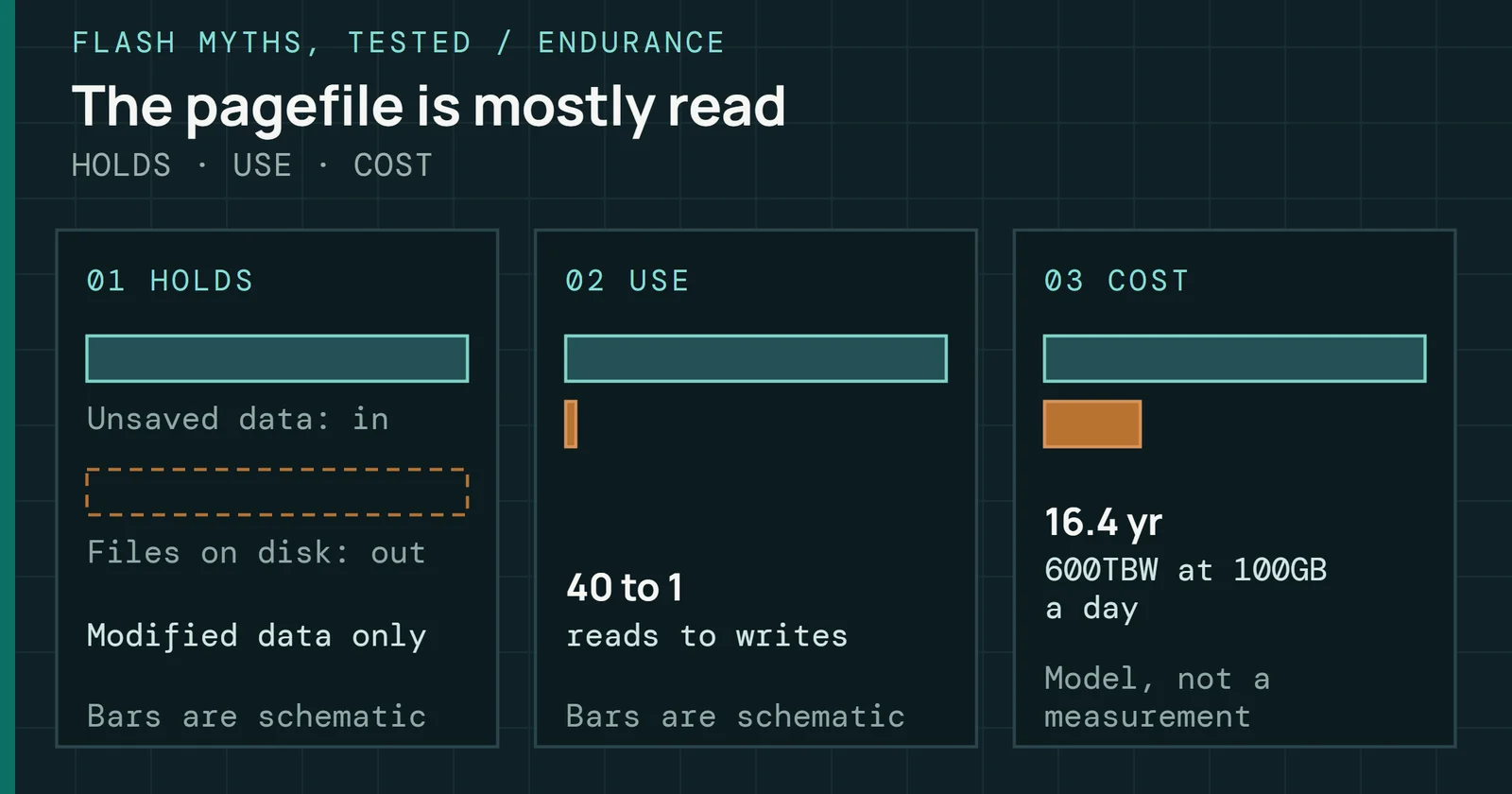
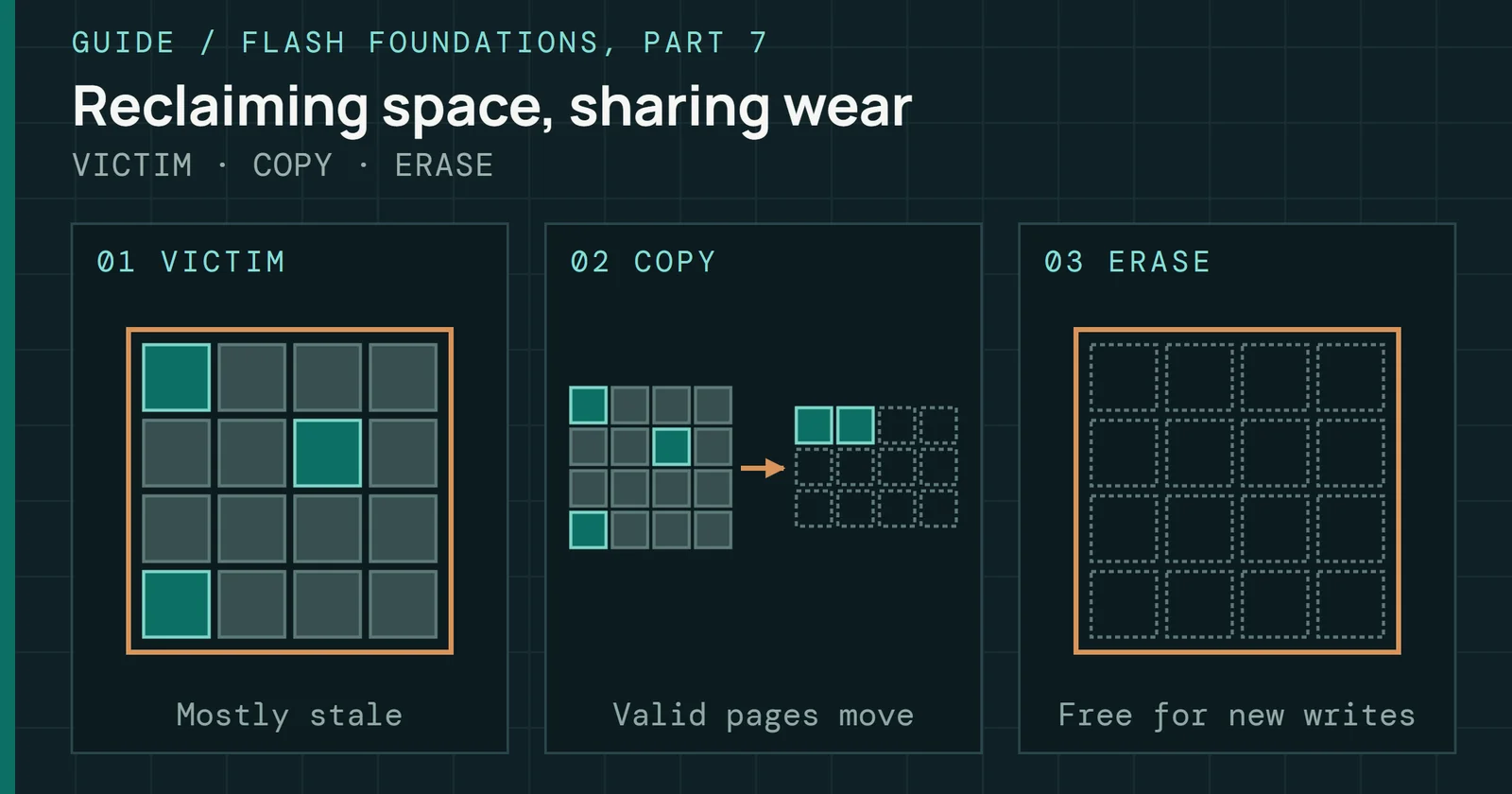
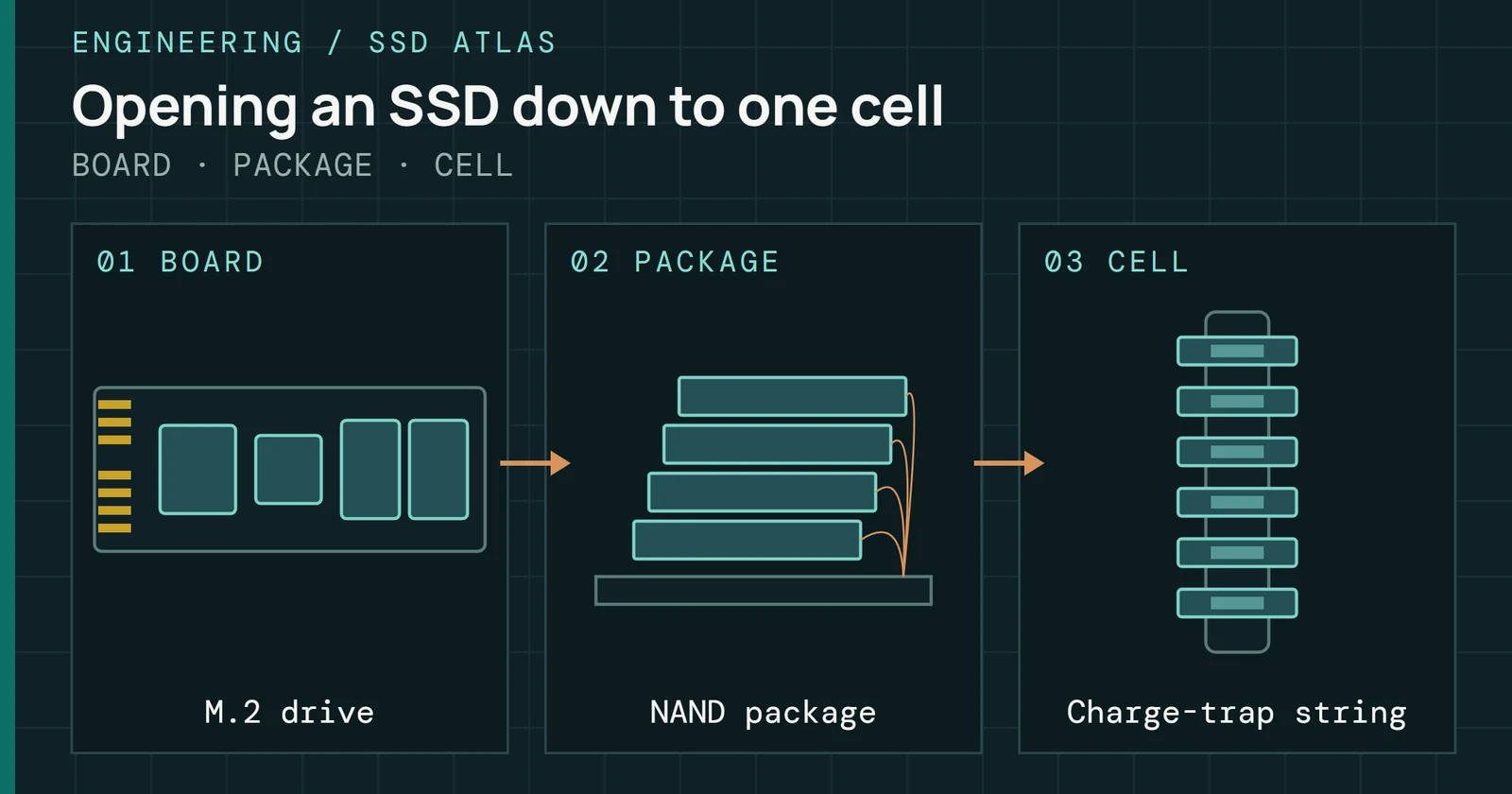
Flash cannot overwrite a page in place. Instead, the controller writes new data to a fresh page and later erases a whole block, and before it erases a block it has to copy out any pages in it that are still valid. Those copies are extra writes. Divide all the writes the flash receives by the writes the host sent and you get the write amplification factor, WAF. Flash Foundations Part 7 walks through the mechanism.
Where the myth comes from
Copying valid pages out before an erase is the extra write
Why garbage collection makes write amplification
One result produced the advice. SNIA’s endurance white paper says WAF is inversely proportional to overprovisioning, because the spare NAND is what garbage collection works in. More room to work means emptier blocks to reclaim and fewer copies. Free space on a drive looks like more room to work, so the advice is to keep a lot of it.
The word “free” needs care. There are two kinds of spare on an SSD, and the advice treats them as one.
Two kinds of spare
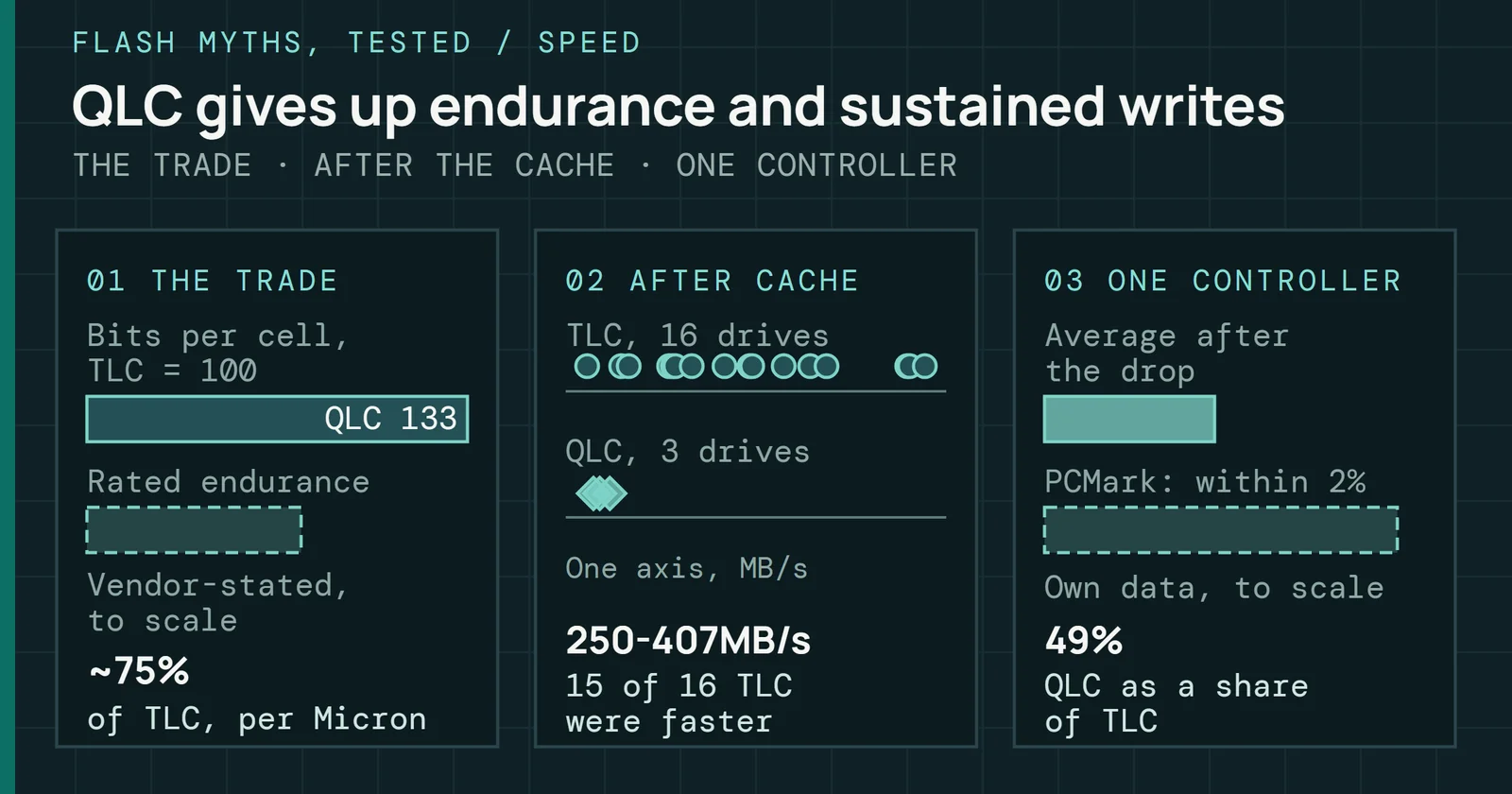
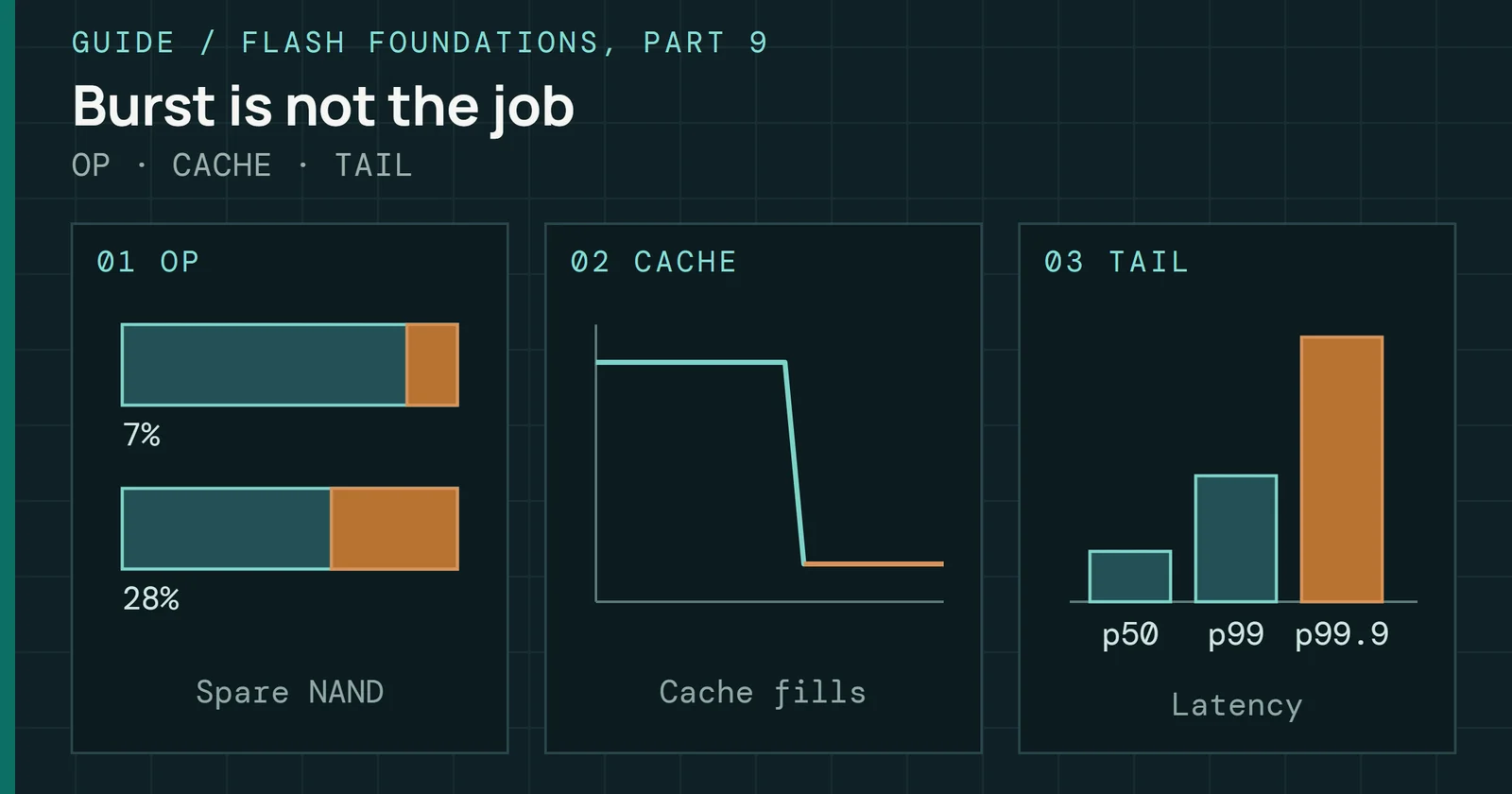
One kind is built in. Raw NAND is sized in GiB and drives are sold in GB, so a drive with 1,024GiB of raw NAND holds about 7.37% more than 1,024GB, and that gap is spare on every drive. Vendors then reserve more on top. Part 9 gives typical marketed ranges, labeled illustrative, from 7% on value consumer drives to 25% to 28% on enterprise drives. This spare is always there, whatever you store.
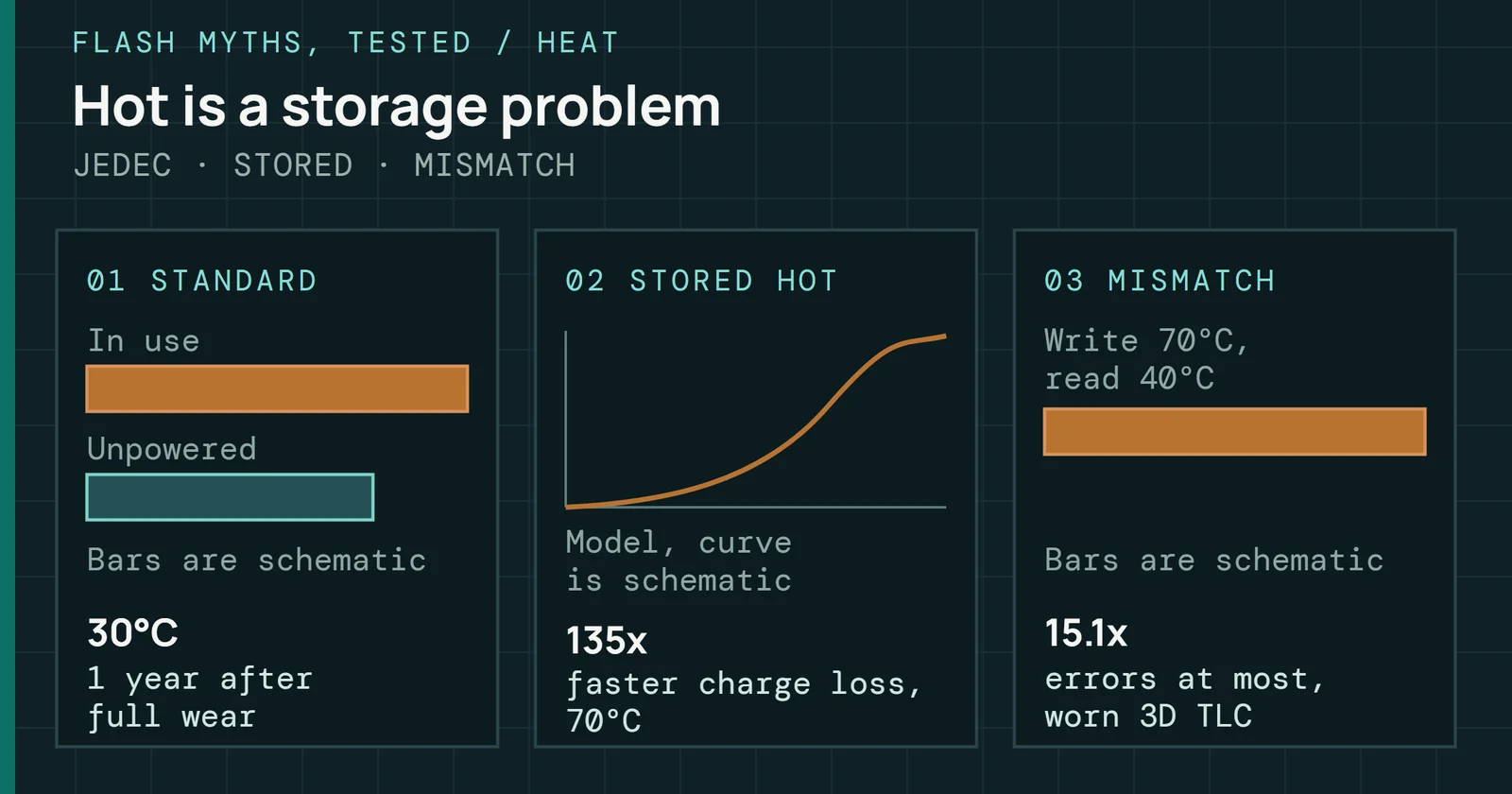
Free space you keep is the other kind. Your file system is invisible to the drive. As far as the controller knows, a page is valid until the host overwrites that address or sends TRIM for it. Micron’s brief on its dynamic write acceleration says that without TRIM the drive’s logical saturation keeps rising, and that this can happen even when the partition shows the volume as mostly empty. So empty space in Explorer is only spare if the drive has been told about it.
Two kinds of spare
More factory spare cuts write amplification on a full drive
Uniform random writes over the whole drive, no deleted files
Figure 1 shows what the built-in kind is worth on a drive that is completely full. Its two dashed “Model” bars come from the FTL & GC Sandbox’s own simulated workload on a small drive of 256 blocks with uniform random writes and greedy garbage collection, giving a WAF of about 9.1 at 7% spare and 2.55 at 28%. Park et al. published an analytic model for uniform random writes and greedy collection; evaluating its Eq. 5 gives about 7.8 at 7% and 2.48 at 28%. The solid bar is their measurement of a real 240GB Samsung 843TN with 23.4GB of overprovisioning, after filling it with 102.1GB of cold data so its effective spare factor was 0.28. Their 8KB uniform random writes to 112.9GB of hot data gave a WAF of 2.466, which the chart’s solid bar rounds to 2.47.
Two models of the same workload give different answers where WAF is steepest. At 7% the sandbox reads about 9.1 against about 7.8 from the published model. At 28% the sandbox, the model and the drive land within a few percent of each other, at 2.55, 2.48 and 2.466. On its own page, the sandbox notes that its simulator holds a few blocks in reserve, which the textbook line does not. Flash Foundations Part 7 explains how the published model works and where its assumptions stop.
What free space does when the drive knows
I can also hold the factory spare at 7% in the sandbox and change how full the drive is. This is one deterministic run of the sandbox’s ftl-sweep.ts on 2026-10-31, one run per point with no repeats, on 256 blocks of 64 pages with uniform random writes, greedy garbage collection, and a delete-and-create event about every 32 host writes. Each point runs 6 writes per logical page and measures the second half.
What free space does when the drive knows
Free space only helps when the drive has been told it is free
Model drive, 7% factory spare, uniform random writes, greedy GC
Figure 2 has two curves. With TRIM on, deleted space returns to the drive’s free pool, so free space acts as extra spare. WAF is 1.2 at 50% full, 1.68 at 70%, 2.23 at 80%, 3.5 at 90%, 5.0 at 95% and 9.11 at 100%. Cost rises slowly at first and then steeply, and the steep part starts above 80%.
With TRIM off, deleted files stay valid in the drive’s eyes until their addresses are reused, so the drive drifts back toward a full one. WAF is 4.9 at 50% full, 7.92 at 70% and 9.04 at 90%, and the two curves meet only at 100%. In this model, half the drive empty without TRIM does worse than a drive 90% full with it.
This is a model with a deliberately hard workload. Every write goes to a random address across the whole data set, which is the case where garbage collection finds the most valid pages in each block. On its own page, the sandbox notes that a drive less than full does better than the textbook line.
What a real drive did
Park et al. also tested the Samsung 843TN as a drive in use. They built an EXT4 file system on a 215GB partition, wrote one hot file and one cold file, and filled the partition to between 60% and 90% utilization. The hot file took 10% to 40% of the partition, and they sent 8KB direct random writes to it.
What a real drive did
Four tabulated cases on a real drive stayed at or below 1.52
Samsung 843TN, EXT4 on a 215GB partition, 8KB random writes to the hot file
Figure 3 shows the four cases the paper tabulates. Write amplification was 1.19 at 80% used with a 30% hot file and 1.17 at 90% used with a 20% hot file. At 90% used with a 30% hot file it was 1.341, and with a 40% hot file it was 1.518. In most cases the measured WAF was below 1.2, and with a small hot file at 60% and 70% used it was only slightly over 1.
The paper also ran Filebench fileserver and Varmail, Sysbench OLTP and Cassandra with YCSB on the same drive. Write amplification rose with utilization but did not exceed 1.2. Meanwhile the analytic models, which assume a full drive and uniform random writes, predicted 4.08 for that partition’s spare factor of 0.147. Park et al. conclude the models are limited when utilization and workload pattern vary.
The full-drive, all-random case in Figure 2 is a worst case. With one hot file that was a fraction of the partition and one cold file, the drive at 90% full amplified random writes to the hot file by a factor between 1.17 and 1.52. The sandbox’s run at 90% full with TRIM on gives 3.5. This evidence is one paper, one drive and one file system. I have no saved measurement of a current consumer drive at different fill levels.
The other cost of a fuller drive
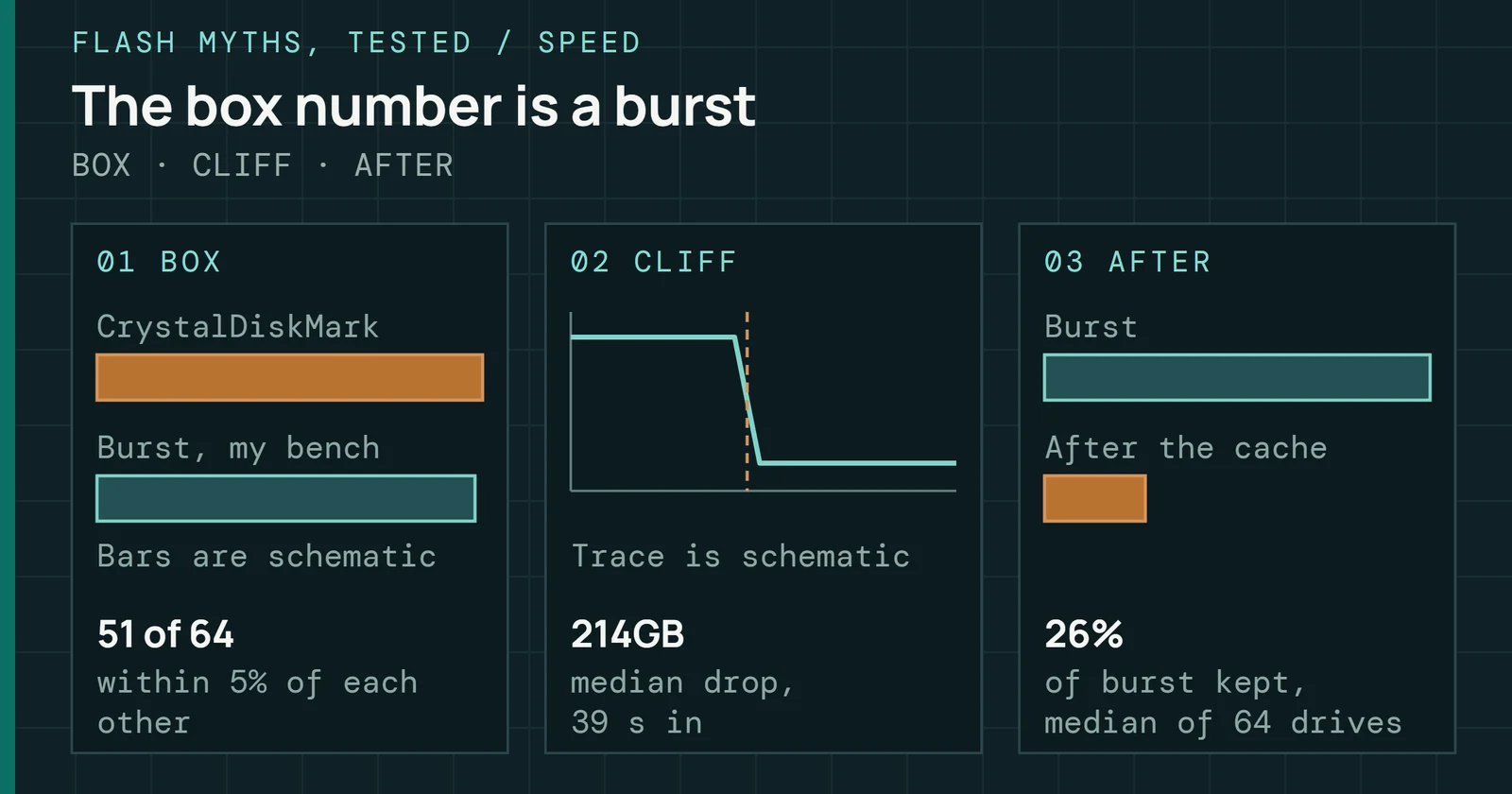
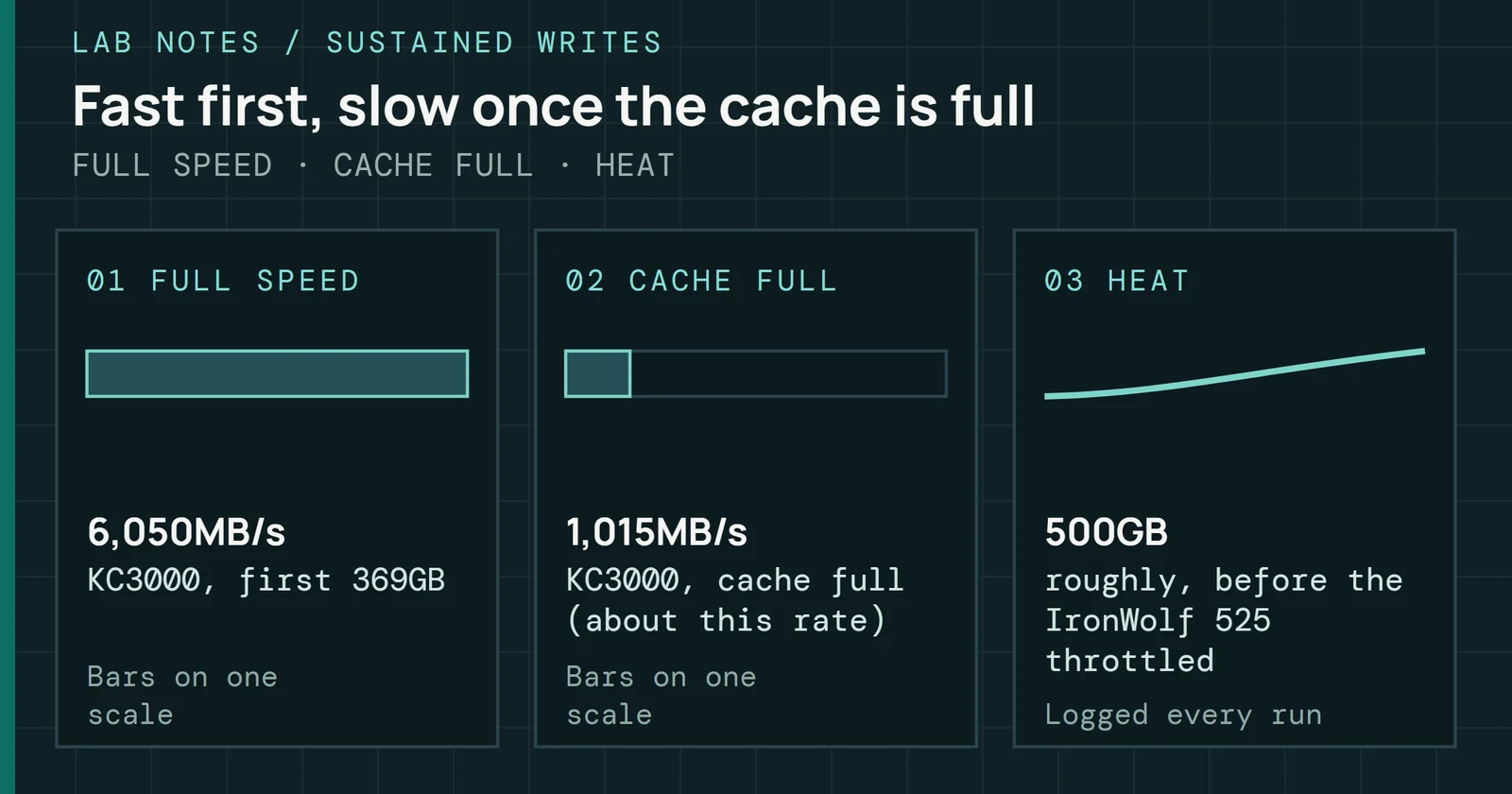
Write amplification is not the only thing free space buys. Most modern SSDs size their SLC write cache dynamically from the amount of data stored, according to Yang et al.. Advantech’s white paper says the cache size differs with the free space on the drive, so larger and less occupied drives can write more data at peak speed than drives nearing full capacity. Micron’s brief draws the contrast with a static cache, which takes its space by limiting the user-accessible capacity of the drive.
The other cost of a fuller drive
A fuller drive has less room for its SLC write cache
Drive capacity, split by what fills it
Burst speed, then, is a second reason to keep some room. Part 9 draws the shape of this with illustrative values, and the box-speed myth shows what happens to write speed once the cache is spent. I have no saved source that gives a fill percentage where a given consumer drive loses its cache, so I will not name one.
What to do
Do not run an SSD to the brim, and do not bother leaving half of it empty. In the sandbox, the cost of fullness climbs steeply past about 80% under a worst-case workload, and the real drive stayed at or below 1.52 in all four tabulated cases. My reading of the two together is that a normal desktop gains little from holding back more than a modest margin, and that a heavy random-write job, such as a database or scratch volume, is the case where headroom pays.
Make sure TRIM is working, because it decides whether your free space counts at all. TRIM Check reads one command on your machine and shows whether it is on, and the manual TRIM myth tests what a late or missing TRIM costs.
What to do
Check TRIM, keep a modest margin, buy spare for random writes
In the order to act on them
If your job is sustained random writes, buy the spare instead of borrowing it. A drive with more factory spare keeps its advantage whatever you store on it, and Figure 1 shows what that spare is worth.